Designing Brevo’s AI experience
Turning an AI-first ambition into a coherent product system.
I led the definition of Brevo’s AI experience framework, establishing a shared model for how intelligence assists, recommends, executes, and orchestrates across the product.
The framework connects product strategy, agentic architecture, and user experience, giving teams a common foundation to design AI-powered experiences at scale.
Company : Brevo — European SaaS CRM unicorn, serving 600,000+ customers globally across Marketing, Sales and Customer Experience.
Role : Unified UX and Design System Manager
Scope : AI Experience Strategy · Interaction Design · Design System · AI Product Foundations · Agentic Architecture
Timeline: 2025 to present
Collaboration: Product · Product Design · Content Design · Engineering · Brand
01 – The challenge: AI features don't create an intelligent product
As Brevo entered its next phase of growth, AI was becoming a company-wide ambition, but the market was already saturated with AI promises, assistants, and isolated “magic” features.
Across the product, teams were exploring opportunities to generate content, surface insights, automate actions, and introduce more intelligent workflows.
Individually, these initiatives could create value. But together, they introduced a new risk: adding more AI features wouldn't necessarily make Brevo feel more intelligent.
Without a shared model, each product team could define its own capabilities, interaction patterns, level of autonomy, and relationship with the user, creating a collection of disconnected AI experiences rather than one coherent product intelligence.
The opportunity was therefore bigger than designing an assistant. We needed to rethink how intelligence could connect context, data, insights, decisions, and actions across the product, helping users do things better, faster, and with more clarity, without taking control away from them.
Our problem became:
How might we enable teams to build AI capabilities at scale while making Brevo feel like one coherent intelligence?
Different teams, different AI experiences.
Generate Automation – Refine text in campaign editor – Generate Segment – Write Email subject line.
02 — We stopped designing features. We started designing capabilities.
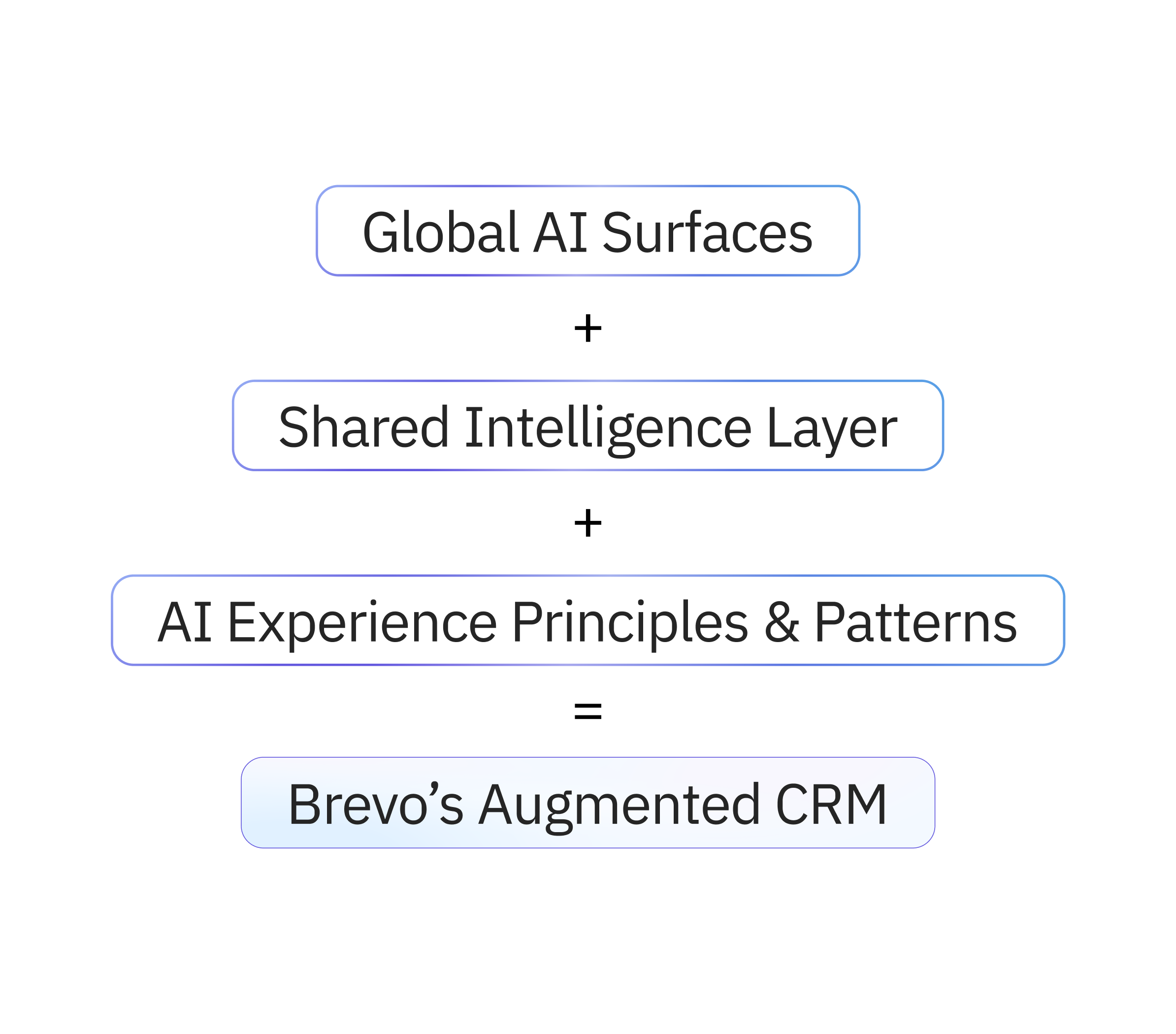
The vision became the Augmented CRM: an intelligence designed to assist and upskill users, helping them understand more, decide better, and act faster.
To make that vision tangible, we introduced Aura, Brevo's intelligent layer. Rather than a standalone assistant or AI embedded independently within each product, Aura was conceived as a shared system that could operate across the entire Brevo experience.
At its core, the system connects two layers:
Intelligence layer
Reusablecapabilities defining what the system can understand and do.Experience layer
Global interaction surfaces making those capabilities accessible wherever users work across Brevo.
Intelligence layer
The intelligence layer is structured around four types of skills:
| AI primitive skill | Shared atomic capabilities that power the system and can be reused across experiences. |
| Execution skill | Turns intent into action, changing or generating outputs in the product. |
| Insight skill | Watches, thinks, and recommends by analyzing context and data to surface risks, opportunities, and suggested actions. |
| Orchestration skill | Combines capabilities into missions and determines what happens next, within defined rules and guardrails. |
Together, they create one intelligence that can be reused, composed, and surfaced across the entire product.
Technically, these capabilities can be implemented as skills or agents depending on their complexity and autonomy.
The framework was intentionally technology-agnostic: its purpose was to give a broad audience across Product, Design, and Engineering a shared mental model of how the system understands, recommends, acts, and orchestrates, without requiring everyone to understand the underlying agentic architecture.
A shared intelligence model connecting reusable capabilities, actions, insights, orchestration, and user feedback across Brevo.
03 — One intelligence, wherever users need it.
The experience layer makes Aura available across Brevo, adapting its presence to the user’s context and the complexity of the task.
Aura was designed to meet users where the work happens, rather than becoming another destination they need to visit.
Its presence adapts to the task, from lightweight assistance to focused work, embedded creation, or proactive recommendations.
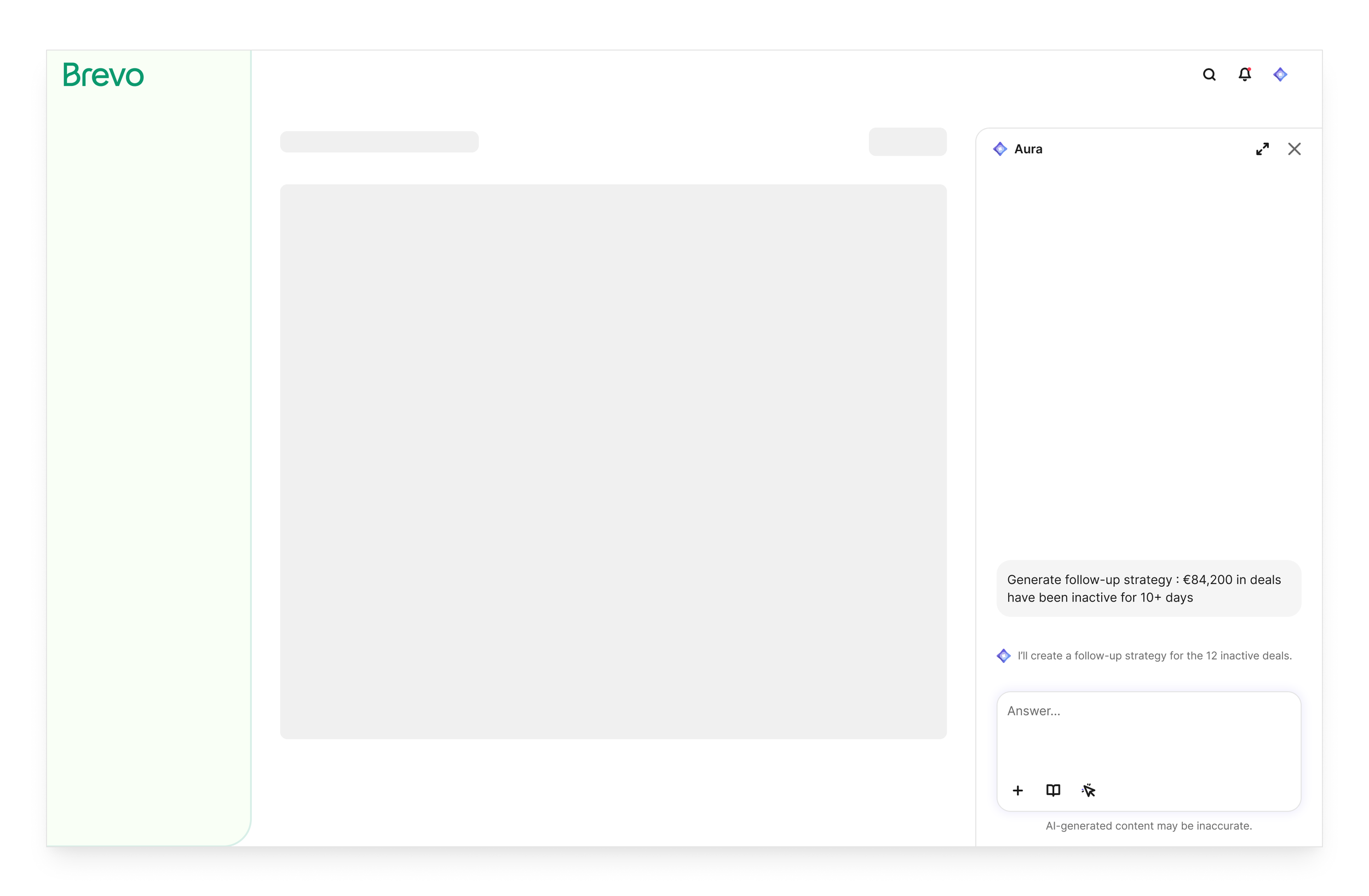
| Compact mode | A persistent assistant in a drawer alongside the product experience. Users can get support without leaving their context, and seamlessly switch to Focus mode when a task requires more space. |
| Focus mode | An expanded Aura experience for more complex tasks requiring deeper focus, such as generating and refining an artifact alongside its preview. Users can seamlessly return to Compact mode at any time. |
| Editor mode | Embeds Aura directly within creation surfaces, making conversational assistance available inside editors where users create and refine content. |
| Contextual recommendations | Proactive suggestions surfaced directly within the product when Aura identifies a relevant insight, opportunity, or next action. Users can act immediately or continue the interaction with Aura. |
These surfaces aren't separate AI experiences. They provide different levels of engagement with the same intelligence, allowing Aura to move between proactive assistance, conversation, creation, and execution without breaking the user's workflow.
Users don’t have to go to AI. AI comes into the experience when it becomes useful.
Aura adapts its presence to the task — from lightweight assistance to focused work and embedded creation.
Compact mode · Focus mode
Editor mode · Contextual recommendations
04 — Turning the vision into a foundation teams could build on.
We used the Design System to turn the AI experience into a shared, buildable foundation for product teams across Brevo.
The first step was to bring teams into the journey.
We brought Product Managers and Designers together to imagine what Aura could eventually create across Brevo, from campaigns and automations to reports, segments, tasks, and CRM objects.
Beyond identifying shared needs, the workshop created momentum around Brevo's new AI direction, giving teams a concrete way to explore what the Augmented CRM could mean for their own domains.
This work helped us prioritize the first foundations: Global Aura surfaces, artifact patterns, previews, and the DS components required to support them.
My team and I designed these foundations, then worked with our DS engineers to bring the first MVP into production.
This shell is intentionally evolving, designed to expand as new use cases, capabilities, and agentic interactions emerge.
Cross-team explorations across product domains helped us identify Aura’s shared foundations.
The exercise surfaced recurring patterns across very different product objects, revealing what could become shared AI foundations.
05 — Testing the system before shipping it.
The experience framework is taking shape, while the agentic architecture behind it still requires time, experimentation, and validation.
None of these experiences are live today. As the underlying architecture continues to evolve, we are using prototypes to test the experience against real product use cases and learn what the system actually needs.
AI is also pushing the product itself to evolve.
As new use cases emerged, they exposed the need for new interaction patterns and foundational capabilities in the Design System.
Generating an SMS campaign
Creating an SMS campaign showed that a prompt alone isn't always enough to generate the right artifact. This led us to introduce refinement questions, both as a new foundational AI capability and a new interaction pattern in the Design System.
Generating a Segment
Creating a segment challenged another assumption: not every artifact needs a preview. Depending on what is being created, the artifact itself can provide enough context to understand and act.
06 — From AI ambition to a shared product direction.
The outcome isn't a finished AI product yet. It's a shared foundation for what Brevo's AI experience can become.
What started as an ambition to make Brevo more intelligent became a common model for how intelligence and experience should work together across the product.
The framework gave teams a shared direction, reusable foundations to build on, and a way to explore new AI use cases without creating disconnected experiences.
The work continues as the agentic architecture matures and new use cases emerge.
But the foundation is now in place for Brevo to evolve toward the Augmented CRM.